
Can Dry Socket Heal On Its Own? Honest Answer
The Short Answer
Yes, dry socket can heal on its own — but it takes 7 to 14 days of significant pain, and you risk a secondary infection during that window.
Professional treatment makes you comfortable in hours, not days. For most patients, the choice is:
- With treatment: Significant relief in 1 hour, normal in 5–7 days
- Without treatment: Severe pain for 7–10 days, full healing in 2–3 weeks
Both paths reach the same end. The question is how much pain you're willing to endure to get there.
Why Dry Socket Eventually Heals on Its Own
The body is remarkable at wound healing. Even without intervention, the socket eventually:
- Forms a new layer of granulation tissue over the exposed bone
- Builds new soft tissue (epithelium) over that
- Slowly remodels the underlying bone
- Closes the socket completely
This natural healing process happens whether you're treated or not — but treatment dramatically shortens the painful window.
What Happens If You Don't Get Treatment
Here's the realistic timeline of untreated dry socket:
Days 1–3 of dry socket (typically days 3–5 after extraction)
- Severe throbbing pain
- Pain medication helps only modestly
- Sleep is difficult
- Eating is painful
- Bad taste develops
- Most people miss work or school
Days 4–7
- Pain remains severe but may plateau
- Bad breath persists
- Risk of secondary infection rises (food trapping)
- Some patients develop low-grade fever from local inflammation
Days 8–14
- Pain gradually improves
- Granulation tissue begins covering the bone
- Mild discomfort and bad taste continue
- Risk of bone exposure causing minor pieces to flake off (sequestrum)
Weeks 2–4
- Soft tissue covers the socket
- Bad taste resolves
- Discomfort minimal
- Healing essentially complete
Risks of Skipping Treatment
While most untreated dry sockets eventually heal without serious complications, you face several avoidable risks:
1. Secondary infection
The exposed socket is a perfect environment for bacteria. Food and debris collect, and an opportunistic infection can develop. This requires antibiotics and turns a localized problem into a systemic one.
2. Osteomyelitis (rare but serious)
In very rare cases, untreated dry socket can progress to bone infection — a serious condition requiring extended antibiotic therapy and sometimes surgery.
3. Delayed implant timeline
If you're planning a dental implant in the same area, an untreated dry socket can delay placement by weeks longer than a treated one because the bone needs more time to recover.
4. Sleep disruption and quality of life
A week of poorly controlled pain has real consequences — missed work, disrupted sleep, mood effects, and reliance on stronger pain medications.
5. Opioid exposure
Patients trying to manage untreated dry socket pain often end up on opioid medications for longer than necessary. Even short-term opioid use carries dependency risk.
Why Treatment Is So Effective
A medicated dressing placed in the socket:
- Numbs the exposed bone within minutes (eugenol/clove oil)
- Reduces inflammation at the site
- Prevents food impaction by physically sealing the socket
- Provides an antimicrobial barrier
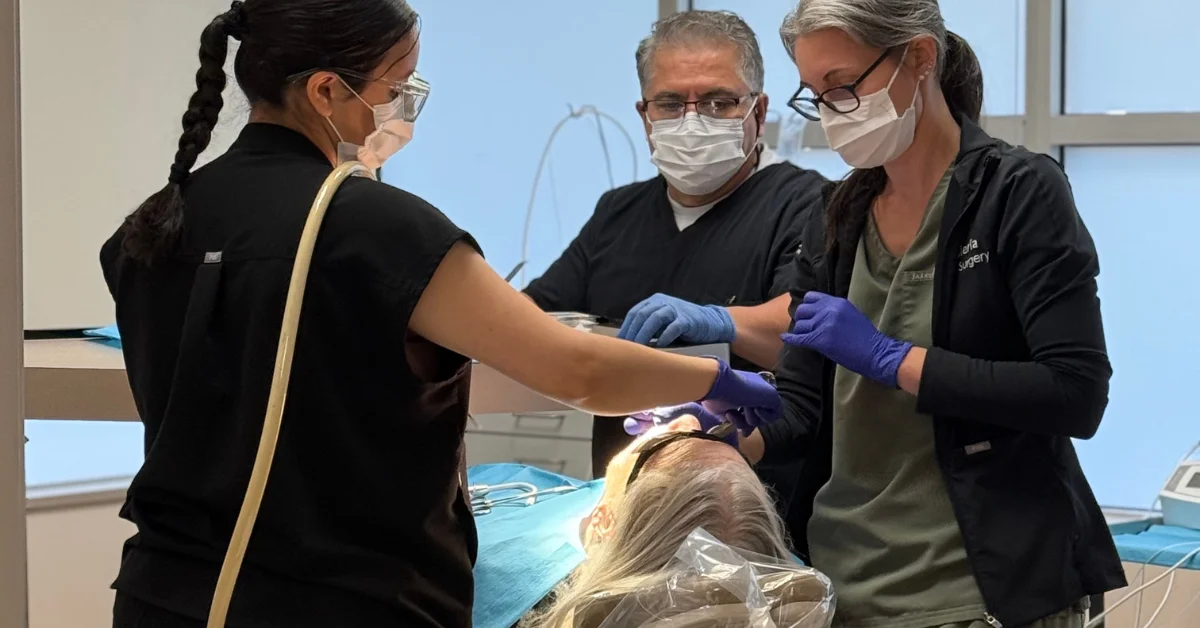
The treatment is fast (5–10 minutes), inexpensive, and almost universally effective.
When Self-Care Makes Sense
For very mild cases that you suspect but aren't certain, a 24-hour observation with intensive home care may be reasonable:
- Gentle warm salt-water rinses every 2–3 hours
- Soft food, no smoking, no straws
- Scheduled ibuprofen + acetaminophen combination
- Cold compress to the cheek for swelling
- Sleep with head elevated
If you're not feeling significantly better in 24 hours, it's time to be seen.
Note: This is monitoring, not treatment. If symptoms confirm dry socket, professional care is the right answer.
Things You Should NOT Do at Home
Online forums sometimes suggest these — they don't help and can make things worse:
- Packing the socket with cotton or gauze — risks worsening infection and is not the same as a medicated dressing
- Applying clove oil directly to the socket — can chemically burn tissue
- Using oil of oregano or other essential oils — irritating
- Rinsing with hydrogen peroxide repeatedly — disrupts healing tissue
- Applying alcohol-based products — burns and slows healing
- Probing the socket with a toothpick or finger — introduces bacteria
When You Absolutely Must Be Seen
Even if you've decided to ride it out, see your oral surgeon if you develop:
- Fever above 101°F
- Spreading redness or swelling
- Pus or yellow drainage
- Numbness or tingling in the lip, chin, or tongue
- Increasing difficulty opening your mouth
- Pain that hasn't improved at all by day 5
These signs may indicate complications beyond simple dry socket.
The Cost Argument
Some patients delay treatment because of cost concerns. The reality:
- Dry socket treatment: typically $75–$150, often covered by insurance
- Antibiotics for secondary infection: $20–$80 plus a separate office visit
- Days of missed work: typically 2–3 days
- Stronger pain medication: prescription costs
Treatment almost always costs less in time, money, and quality of life than letting it run its course.
When Treatment Isn't Available
If you're traveling or somewhere without access to dental care:
- Take ibuprofen 400–600 mg with food every 6 hours, alternating with acetaminophen 500–1000 mg in between
- Gentle warm salt-water rinses every 2–3 hours
- Soft foods only, drink water from a cup
- Absolutely no smoking, alcohol, straws, or vigorous activity
- Find a dentist or oral surgeon as soon as possible
Urgent care centers and emergency rooms can provide pain management but typically can't treat the socket itself — you'll still need to see a dentist or oral surgeon.
Frequently Asked Questions
How long does untreated dry socket last?
Severe pain usually lasts 7–10 days. Full healing takes 2–4 weeks.
Can dry socket get worse over time?
The pain typically peaks days 3–5 of dry socket onset, then plateaus, then slowly improves. If symptoms get progressively worse instead of plateauing, suspect infection and seek care.
Will I lose the bone if I don't treat dry socket?
Significant bone loss is rare. Minor flakes of dead bone (sequestra) may extrude during healing — that's normal and not dangerous.
Can I take antibiotics instead of getting the socket treated?
No. Dry socket is a clot/wound problem, not an infection. Antibiotics don't treat it.
Is over-the-counter clove oil safe to use on dry socket?
Direct application to the socket can chemically burn tissue. The medicated dressing used in the office is a controlled formulation. Don't try to recreate it at home.
Can I just take painkillers and wait?
You can — but you'll be miserable for a week, you risk secondary infection, and treatment is fast and inexpensive. There's almost no good reason to wait.
Why suffer when treatment takes 10 minutes? Contact us for same-day dry socket care. Most patients feel dramatic relief within an hour of being seen.
Related reading
Ready to Transform Your Smile?
Schedule your free consultation today and discover how dental implants can change your life.