
Denture Alternatives That Work: Your 2026 Guide to Permanent Smile Restoration
Medically reviewed byDr. Alexander Antipov— 2026-07-20
The denture alternatives that actually work in 2026 are implant-based: fixed All-on-4 bridges that never come out, and snap-in implant dentures that click securely onto titanium posts. At Fusion Dental Implants in Roseville and El Dorado Hills, board-certified oral surgeons deliver both with same-day Teeth in a Day treatment, so you can leave your denture behind the same afternoon as surgery.
This is general information, not medical advice. Whether a fixed bridge, snap-in denture, or another option fits you depends on your exam and 3D imaging.
| Option | Removable? | Stops bone loss? | Chewing power | Best for |
|---|---|---|---|---|
| Traditional denture | Yes, rests on gums | No | Fraction of natural bite | Lowest upfront cost only |
| Snap-in implant denture | Yes, clicks onto 2 to 4 implants | Yes, at implant sites | Strong improvement | Stability on a budget |
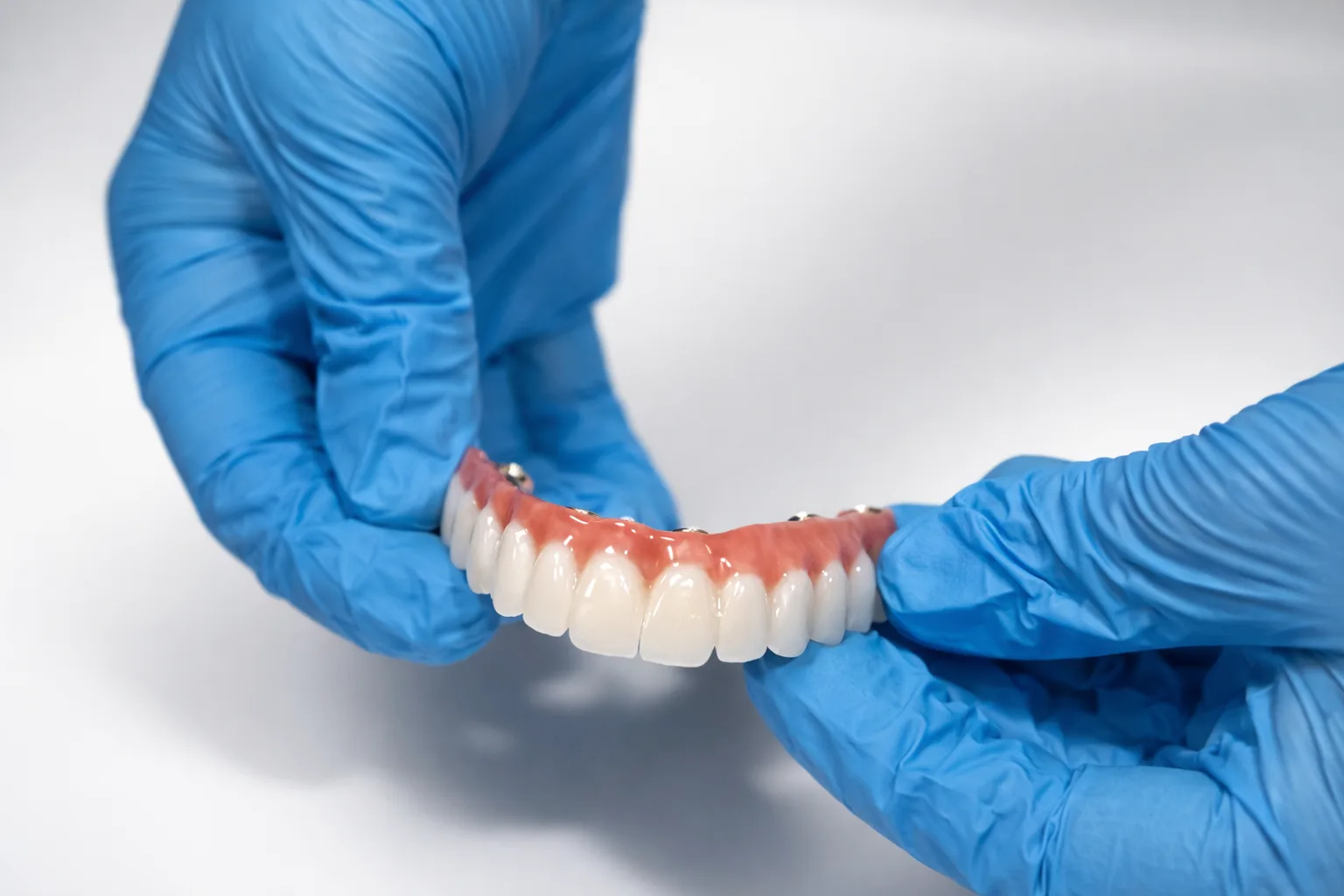
| Fixed All-on-4 bridge | No, stays in around the clock | Yes | Close to natural teeth | Permanent, most natural result |
Why Traditional Dentures Fail, and What "Working" Actually Means
Most denture wearers know the cycle: slipping plates, messy adhesives, sore spots, and the quiet habit of ordering soft food. That is denture fatigue, and it is not just annoying, it is biological. Because a denture only sits on the gums, it does nothing to stimulate the jawbone underneath. The bone starts shrinking almost immediately after teeth are lost, which is why dentures loosen over time, need repeated relines and replacements every five to seven years, and why long-term wearers develop the sunken facial look of bone resorption.
A denture alternative "works" when it solves three problems at once: it stays put mechanically, it protects the jawbone underneath, and it looks and feels like natural teeth. Only implant-based solutions check all three boxes, because titanium posts fused into the bone act as artificial tooth roots. That root replacement is what stops the shrinkage. The FDA's overview of dental implants is a good neutral primer on how these devices anchor artificial teeth while helping preserve bone.
Fixed Full-Arch Bridges: The Gold Standard
If your goal is a smile that never comes out, All-on-4 full-arch treatment is the benchmark. Four to six implants per arch support a complete fixed bridge:
- Angled placement uses the bone you have. The back implants are tilted to anchor in the denser bone at the front of the jaw, which often eliminates bone grafting even after years of missing teeth.
- No plate over your palate. Unlike an upper denture, a fixed bridge leaves the roof of your mouth open, so food tastes like food again and speech is clear.
- Same-day results. With the Teeth in a Day protocol, you arrive with failing teeth or a denture and leave the same afternoon with a fixed, functional temporary bridge. Dr. Antipov walks through how that works in his Teeth in a Day explainer.
- Material choice matters. The posts are medical-grade titanium; the bridge can be acrylic or zirconia. Zirconia costs more but resists staining and fracture and mimics natural enamel. See our comparison of zirconia vs. acrylic full-arch teeth.
Once healed, a fixed bridge lets you bite into apples, steak, and nuts with confidence, and you care for it by brushing and water flossing, not soaking it in a cup.
Snap-In Dentures: The High-Performance Middle Ground
Not everyone needs or wants a fixed bridge, and snap-in implant dentures are the strategic middle option. Two to four implants are placed in the jaw, and your denture clicks onto locator attachments instead of relying on suction or paste.
The lower jaw is where snap-ins shine most. A conventional lower denture floats because the tongue and floor of the mouth constantly move it; just two implants stabilize it dramatically, ending the sore spots and the fear of teeth popping out mid-sentence. Snap-ins cost less upfront than a fixed arch, work well for patients with more limited bone, and still halt bone loss at the implant sites. The tradeoffs: you remove them at night for cleaning, and the attachments and denture base need periodic maintenance as gums change. Our guide to permanent dentures: fixed vs. snap-in breaks down which suits which patient.
Costs, Longevity, and the Value Question
Traditional dentures win on entry price and lose on nearly everything else. Over a 10 to 20 year horizon you pay repeatedly for adhesives, relines, and full replacements, plus the harder-to-price costs of restricted diet and ongoing bone loss, which makes every future fix more complicated. Implant solutions cost more upfront and then mostly stop costing you: the posts are permanent, and bone preservation means your face and your options stay intact.
At Fusion Dental Implants, fixed All-on-4 treatment starts at $17,999 per arch with all-inclusive pricing, and we back it with a price match guarantee: if a local board-certified specialist quotes the same treatment plan and materials for less, we match it. Most patients manage the investment with monthly payment plans, HSA or FSA funds, and whatever insurance benefits apply; our guide to dental implant financing in California covers the options, and current programs are on our costs and financing page.
Choosing the Right Specialist
The single biggest variable in your outcome is who does the surgery. Full-arch loads, tissue management, and bone-loss cases are surgical problems, and a board-certified oral surgeon handles them every day, with training a general dental practice cannot match. That expertise matters most if you have been told you are not a candidate: angled placement, grafting, and advanced techniques rescue many "impossible" cases, as our page on complex and revision implant cases explains. Our comparison of a specialist vs. a general dentist covers what the difference buys you.
At your consultation, expect 3D CBCT imaging that maps your jaw in sub-millimeter detail, a written treatment plan, and one transparent all-inclusive price. Fusion Dental Implants provides same-day full-arch treatment from offices in Roseville and El Dorado Hills, serving the Sacramento region and all of Northern California.
Schedule your free consultation or call (916) 292-9998 to find out which denture alternative fits your anatomy, lifestyle, and budget.
Frequently Asked Questions
Can I get dental implants if I have been wearing dentures for years?
Yes. Long-term denture wear causes bone resorption, but modern techniques work around it. We use 3D imaging to locate the densest remaining areas of your jaw, and angled implant placement often avoids grafting entirely. When bone levels are extremely low, grafting or zygomatic implants can rebuild the foundation needed for a permanent bridge.
Is there an alternative to dentures that doesn't involve surgery?
No non-surgical option provides the stability of implants. Traditional dentures are the only surgery-free choice, but they cannot stop bone loss or prevent slipping. If you want teeth that stay in place and preserve your facial structure, a minimally invasive implant procedure is the only reliable path.
How long do denture alternatives like All-on-4 actually last?
All-on-4 is designed as a lifetime investment. The titanium posts fuse permanently with your jawbone and, with good hygiene and regular checkups, can last the rest of your life. The bridge on top experiences daily chewing wear and may need maintenance or replacement after 10 to 15 years, depending on the material.
Will my insurance cover the cost of denture alternatives?
Most plans offer limited coverage. They may contribute toward extractions or the prosthetic bridge, but surgical implant placement is often classified as elective. Review your policy's major restorative benefits, and ask about financing; most patients combine partial insurance benefits with monthly payment plans.
What happens if I don't have enough bone for dental implants?
Modern techniques often make implants possible anyway. Tilting the back implants lets the surgeon anchor them in the denser bone at the front of the jaw, which is how many patients told they were not candidates end up qualifying. For severe resorption, bone grafting or zygomatic implants can rebuild or bypass the missing foundation.
How do I clean and maintain implant-supported dentures?
It depends on the type. Fixed bridges stay in your mouth: brush twice daily and use a water flosser to clean underneath the prosthetic. Snap-in dentures come out at night for soaking, and the locator attachments get cleaned with a soft brush. Both need professional cleanings twice a year.
Is the dental implant procedure painful?
You should feel no pain during the procedure itself. IV sedation and local anesthetic keep you completely comfortable. Most patients compare recovery to a routine extraction: soreness managed with over-the-counter medication that fades within a few days.
What is the fastest way to replace all of my teeth?
The Teeth in a Day protocol. A board-certified oral surgeon removes failing teeth, places the implants, and attaches a functional fixed temporary bridge in a single visit, so you walk out the same afternoon with a complete set of teeth. The final custom bridge is placed after the implants finish fusing with your bone.
About Fusion Dental Implants: We specialize in advanced dental implant solutions with locations in Roseville and El Dorado Hills, California, serving the Sacramento region and all of Northern California. Call (916) 292-9998 to schedule your free consultation.
Related reading
Ready to Transform Your Smile?
Schedule your free consultation today and discover how dental implants can change your life.