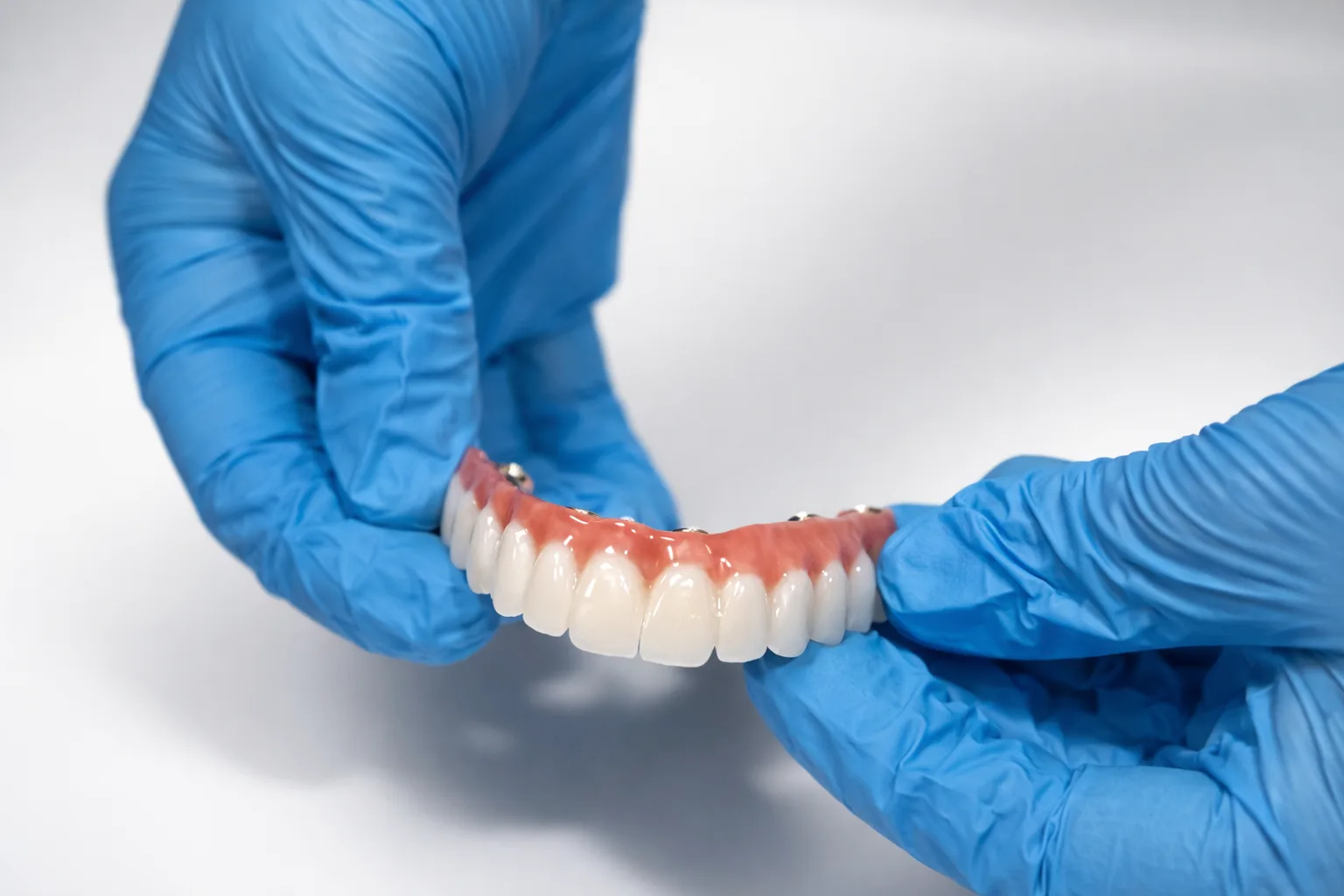
Temporary teeth after dental implants are fixed, natural-looking crowns or bridges attached to your new implants on the day of surgery, worn for roughly 3 to 6 months while the bone fuses underneath, and then replaced with your stronger permanent restoration. At Fusion Dental Implants in Roseville and El Dorado Hills, our board-certified oral surgeons deliver same day teeth for qualifying patients, with single implants from $1,850 and full-arch treatment from $17,999 per arch.
This is general information, not medical advice. Whether you qualify for same day temporaries depends on your bone density and implant stability at surgery, which your surgeon confirms in real time.
Why You Get Teeth the Same Day
The technique that makes same day teeth possible is called immediate loading: attaching a prosthetic to an implant right after placement instead of waiting months. It works only when the implant achieves strong primary stability, the mechanical grip between the post and your bone at the moment of surgery. Your surgeon measures that stability during placement, and the 3D-guided planning done beforehand is what makes hitting dense, supportive bone predictable rather than lucky. Our guide to 3D implant planning explains how that mapping works.
When stability is confirmed, a custom temporary crown or bridge is secured to the implants before you leave. You walk out with fixed teeth, a natural smile line, and normal speech. If stability falls short of the threshold, a staged plan protects your long-term result; a few months of patience beats a compromised implant. Our article on what's realistic with same day implants covers that decision honestly.
The Temporary's Real Job
It is easy to think of the temporary as a cosmetic placeholder. It is actually doing four jobs at once:
- Appearance and speech. You are never without teeth, in photos or in conversation, from day one.
- Gum shaping. The prosthetic supports and contours the gum tissue as it heals, so the final restoration emerges from a natural-looking gumline.
- Site protection. The temporary shields the surgical site and keeps neighboring teeth from drifting into the space.
- A test drive. How you speak, smile, and function with the temporary directly informs the shape, shade, and bite of your permanent teeth.
Why It Is Kept Out of Your Bite
Here is the detail most patients do not expect: your temporary is deliberately designed to take less biting force than your natural teeth, what dentists call being out of occlusion. Underneath it, your bone is fusing to the implant through osseointegration, and that bond is vulnerable to micromovements in the early weeks. Heavy chewing pressure on a fresh implant can wiggle it just enough to disrupt the fusion. Keeping the temporary out of hard contact removes that risk while still giving you a complete smile.
That is also why the soft-food rule matters so much. It is not about the prosthetic being fragile; it is about protecting the biology below it.
Living With Your Temporaries: The Practical Rules
Eat soft, not crunchy. Eggs, yogurt, fish, pasta, soups, well-cooked vegetables, and smoothies without a straw. Avoid nuts, chips, crusty bread, ice, caramel, and anything you would tear or crack with your teeth. Expect this to last until your surgeon confirms fusion, typically 3 to 6 months.
Keep it clean. Brush gently around the prosthetic from day one, use any prescribed rinse, and add a water flosser at the gumline once your surgeon clears it. Hygiene during the temporary phase protects the implants your permanent teeth will depend on.
Watch for warning signs. A temporary that feels loose, shifts, or clicks needs a same-week call to your surgeon, not a wait until the next checkup. Often it is just a retaining screw that needs tightening, but a moving prosthetic can transmit force to a healing implant. Sudden pain increases or fever also warrant a call. The full healing picture is in our recovery day-by-day guide.
Keep your follow-ups. Checkups in the first weeks and months let your surgeon verify the fusion is progressing and the temporary is behaving. These short visits are where small issues stay small.
The Switch to Permanent Teeth
Once your surgeon confirms osseointegration is complete, the temporary comes off and the final restoration goes on. This is more than a swap. The permanent teeth are crafted in high-strength material, typically zirconia for full arches, refined in shade, translucency, and contour, and adjusted so your bite loads evenly across the arch. Everything learned from your months with the temporary feeds into the final design. Our zirconia vs. acrylic comparison breaks down the material choice.
From that point, the soft-food rules end. Permanent implant teeth are engineered for full chewing force, steak and apples included.
Same Day Teeth in Roseville and El Dorado Hills
Immediate loading rewards experience: the surgeon has to place implants precisely enough to achieve stability worth loading, and judge honestly when not to. At Fusion Dental Implants, board-certified oral surgeons plan every case with CBCT imaging and handle everything in-house, from surgery to the final full-arch restoration, backed by our price match guarantee and financing options. We serve Sacramento and all of Northern California from offices in Roseville and El Dorado Hills. For neutral background, see the FDA's overview of dental implants.
Schedule your free consultation or call (916) 292-9998 to find out whether same day temporary teeth are an option for your case.
Frequently Asked Questions
Do I really get teeth the same day as implant surgery?
Qualifying patients do. If the implants achieve strong primary stability at placement, a custom temporary crown or bridge is attached during the same appointment. You leave with fixed, natural-looking teeth while the implants fuse with the bone underneath.
Are the temporary teeth fixed in place or removable?
They are fixed. The temporary is screwed onto the implants and only your surgeon can remove it. It does not come out at night, and it will not shift when you speak, unlike a denture or a flipper.
Why are my temporary teeth kept out of my bite?
The temporary is deliberately made to take less biting force than your natural teeth. Chewing pressure on a fresh implant causes tiny movements that can disturb the bone as it fuses to the post. Keeping the temporary out of heavy contact protects that bond during the critical early weeks.
What can I eat with temporary implant teeth?
Soft foods: eggs, yogurt, fish, pasta, well-cooked vegetables, smoothies without a straw. Avoid hard, crunchy, sticky, or chewy foods like nuts, crusty bread, ice, and caramel for the healing period your surgeon specifies, typically until the implants have fused.
How long do I wear the temporary teeth?
Usually 3 to 6 months, the time osseointegration takes to mature. Your surgeon confirms the fusion is solid before switching you to the permanent restoration. Complex or grafted cases can run longer.
What happens if my temporary tooth feels loose or shifts?
Call your surgeon promptly. A shifting temporary can mean a loose retaining screw, which is a quick fix, but it can also transmit movement to a healing implant. Do not wait for the next scheduled visit and do not try to press it back into place.
Will my permanent teeth look better than the temporaries?
Yes. The temporary is a high-quality acrylic prosthetic designed for the healing phase. The final restoration is crafted in stronger material like zirconia, refined in shade, shape, and bite based on how you functioned with the temporary, and built to take full chewing force.
How do I clean temporary implant teeth?
Gently but consistently. Brush around the prosthetic, use the rinses your surgeon prescribes in the first weeks, and add a water flosser once cleared to keep the gumline under the bridge clean. Good hygiene during the temporary phase protects the implants that your permanent teeth will depend on.
About Fusion Dental Implants: We specialize in advanced dental implant solutions with locations in Roseville and El Dorado Hills, California, serving the Sacramento region and all of Northern California. Call (916) 292-9998 to schedule your free consultation.