What Is Osseointegration? How Dental Implants Fuse With Your Jawbone
Medically reviewed byDr. Alexander Antipov— 2026-07-31
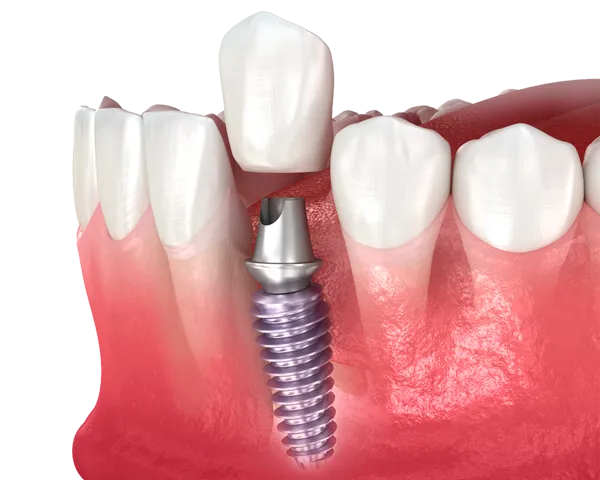
Osseointegration is the biological process where living jawbone grows onto the surface of a titanium implant and locks it in place — a direct, structural bond between bone and metal. It is the entire reason dental implants work: not glue, not cement, not friction, but your own bone accepting the implant as a root. Every other part of implant treatment — the planning, the surgical technique, the healing timeline — exists to protect this one bond.
Our practice is literally named for it. Here is how the fusion actually happens, why it occasionally fails, and what a surgical team does to stack the odds in its favor.
The biology: how bone bonds to titanium
Titanium has an unusual property: its oxide surface is biocompatible, meaning bone cells attach to it directly instead of walling it off as a foreign object. Modern implants amplify this with microscopically textured surfaces that give bone more area to grip.
Once an implant is placed, the bond forms in overlapping phases:
- Clot and scaffold (first days). Blood proteins coat the implant surface, forming the scaffold bone cells will follow.
- New bone formation (weeks 2–6). Bone-building cells migrate to the surface and deposit soft, immature bone directly onto the titanium.
- Remodeling and hardening (months 2–6). The immature bone is steadily replaced by dense, organized bone — the phase that gives the implant its long-term strength.
The whole process typically takes 2 to 6 months — faster in the dense lower jaw, slower in the softer upper jaw. It runs silently in the background; day to day you feel nothing, which is exactly how it should feel. Our implant healing stages guide covers what those months look like from the patient's side, and the NIH's oral health resources offer good independent background on bone biology.
The one rule: no movement
If an implant moves — even microscopically — while bone is trying to attach, the body gives up on bone and grows soft scar-like tissue instead. The implant stays subtly loose and never integrates. Nearly everything a surgical team does traces back to preventing that movement:
| What the surgeon controls | Why it protects the fusion |
|---|---|
| 3D CBCT planning | Places the post in the densest available bone at the correct angle — digital planning before anything touches tissue |
| Gentle site preparation | Overheated bone dies and cannot bond; slow, irrigated drilling keeps it alive |
| Firm initial stability | The implant must be mechanically snug on day one so biology can take over |
| Controlled loading | Any same-day teeth use a rigid, splinted provisional designed to minimize and distribute chewing forces on the fusing implants |
| Health screening | Smoking and uncontrolled diabetes slow bone healing — screened honestly, not skipped |
The journey at a glance: 3D Scan & Planning → Precise Placement → Silent Bone Fusion (2–6 months) → Final Teeth on a Fused Foundation
Why integration sometimes fails — and what happens then
Early failures are uncommon, and almost always traceable: movement during healing, infection at the site, bone damaged by heat during placement, heavy smoking, uncontrolled blood sugar, or an implant asked to survive in bone that was too thin. This is why "cheap and fast" placement is a false economy — the biology does not negotiate. Our guides on why implants fail and whether a failing implant can be saved cover the warning signs and fixes.
When an implant truly never integrates, it is removed — typically a simple procedure — the site heals (sometimes with grafting), and a new implant is placed with adjusted planning. And integration is not the end of the story: the bond must be maintained. The gum seal around a fused implant can still be attacked by infection years later (peri-implantitis), which is why hygiene and checkups protect your investment for decades.
What limited bone means for fusion
Bone that has shrunk after years of missing teeth or denture wear does not necessarily rule out integration — it changes the strategy. Tilted placement anchors full-arch implants in the densest bone you still have; grafting rebuilds volume where needed; and a 3D scan tells you which path your anatomy supports before anything is decided. If you have been told you lack bone, our bone-loss eligibility guide separates the myths from the real limits, and the FDA's dental implant overview explains how implant systems and materials are regulated.
Fusion is the product — everything else is packaging
When you compare implant providers, you are really comparing how well each one protects a biological process you will never see. Board-certified surgical training, 3D planning, gentle technique, and honest candidacy screening are what make the bond succeed — the crown on top is the easy part.
A free consultation with a 3D CT scan at our Roseville or El Dorado Hills office shows you exactly what your bone supports, with transparent itemized pricing — single implants from $1,850, fixed All-on-4 from $17,999 per arch — 0% financing options, and a price match guarantee on comparable local quotes.
Schedule your free consultation
Why patients choose Fusion: In-House Dental Lab | Same-Day New Teeth | Transparent All-Inclusive Pricing | Lifetime Full-Arch Warranty | Price Match Guarantee
Frequently Asked Questions
What is osseointegration in simple terms?
Osseointegration is the process where your jawbone grows onto and bonds with the surface of a titanium implant, making it a load-bearing part of your body. It is not glue or friction — living bone cells attach directly to the implant surface, which is why a fused implant feels and functions like a natural tooth root.
How long does osseointegration take?
Typically 2 to 6 months, depending on your bone density, the implant location, and your overall health. Lower-jaw implants often fuse faster because the bone is denser. Your surgeon confirms integration by testing implant stability before attaching the final restoration.
Can I have teeth while osseointegration happens?
Usually, yes. In qualifying cases, a provisional tooth or full-arch bridge is attached the same day as surgery, rigidly splinted and adjusted to minimize the chewing forces reaching the fusing implants. The final, stronger restoration is attached once integration is confirmed.
Why does osseointegration sometimes fail?
The most common causes are movement of the implant during healing, infection, overheated bone during placement, smoking, uncontrolled diabetes, and placement into bone that was too thin or soft. Most of these risks are controlled by careful surgical technique and honest health screening.
Does osseointegration hurt?
No — the fusion itself is silent and painless. Normal post-surgical soreness fades within days, while the bone quietly remodels around the implant for months. Pain that appears or persists weeks after surgery is not part of normal integration and should be examined.
Why is titanium used for dental implants?
Titanium is biocompatible: bone cells attach to its oxide surface rather than treating it as a foreign object, and decades of clinical use have proven the bond durable. Modern implant surfaces are also textured microscopically to give bone more area to grip.
How do surgeons protect osseointegration during placement?
By placing the implant into the densest available bone at the correct angle using 3D CBCT planning, preparing the site gently to avoid overheating bone, achieving firm initial stability, and controlling the forces on the implant while it heals.
What happens if an implant never integrates?
A non-integrated implant stays slightly loose and is removed — usually a simple procedure. After the site heals, sometimes with bone grafting, a new implant can be placed with adjusted planning. Early failures like this are uncommon and usually traceable to a correctable cause.
This article is for general patient education and is not a substitute for personalized medical advice, diagnosis, or treatment. Every patient's oral health, anatomy, and healing response are different. Consult Dr. Antipov or your dental professional before making treatment decisions.
Sources: FDA: Dental Implants — What You Should Know · NIH/NIDCR: Oral Health Topics
About Fusion Dental Implants: We specialize in advanced dental implant solutions with locations in Roseville and El Dorado Hills, California.
Related reading:
Ready to Transform Your Smile?
Schedule your free consultation today and discover how dental implants can change your life.